
AIRLINE STRIKE COMPENSATION
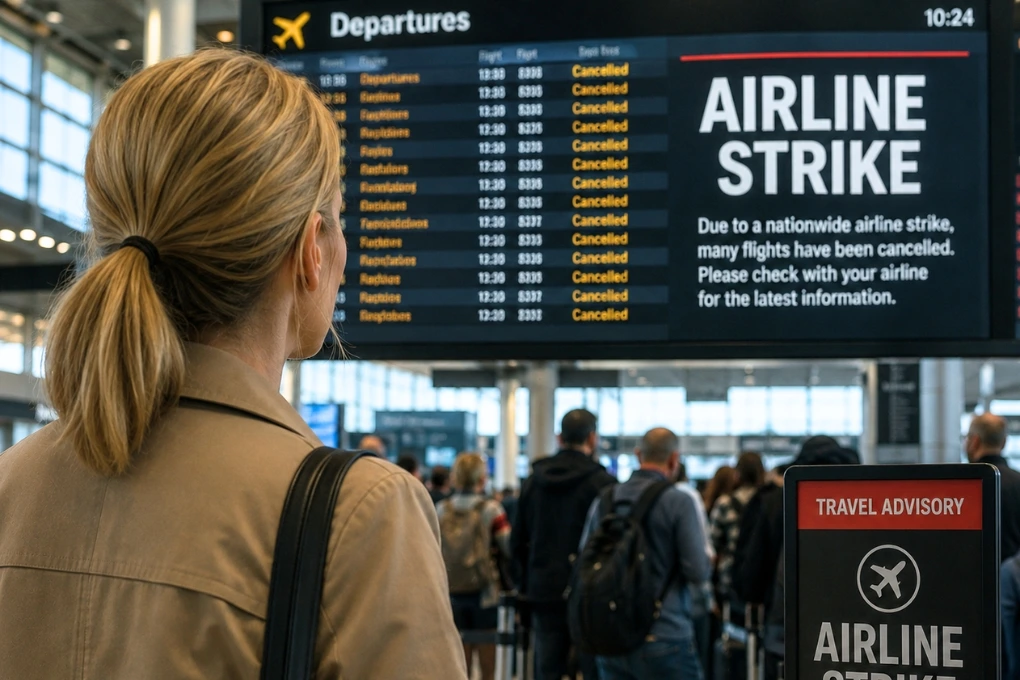
AIRLINE STRIKE COMPENSATION
Flight delayed or cancelled because of Airline strike action? You could be entitled to up to £520 per person or £1,040 per couple in compensation under UK/EU 261. Not all strikes let airlines off the hook, in many cases, you have a legal right to be paid. Air Delayed fights for what you are owed.
If your flight was delayed or cancelled because of an airline staff strike, you could be owed up to £520 per person, or £1,040 per couple in compensation under UK261 and EU261, no matter your ticket price or airline. Strikes by an airline's own staff (pilots, cabin crew, ground staff) aren't classed as "extraordinary circumstances," so you're covered in the same way as any other disruption caused by the airline.
Find out where you stand in minutes, use our free strike compensation tool, enter your flight details, and we'll confirm your eligibility straight away.

Know your rights when a airline strike disrupts your flight
If your flight was delayed or cancelled due to airline staff strike action including pilots, cabin crew or ground handling employees, you may be entitled to compensation of up to £520 per person or £1,040 per couple.
Under a landmark ruling by the Court of Justice of the European Union, internal airline strikes are not considered extraordinary circumstances, meaning airlines cannot use them to avoid paying compensation.
External strikes, such as those involving air traffic controllers or airport security staff, are treated differently and generally do not give rise to compensation.
In addition to financial compensation, airlines must still provide you with a replacement flight or full ticket refund and care and assistance at the airport, even when extraordinary circumstances apply.
Your rights apply whether the strike was announced in advance or came without warning.
UK passengers have up to six years (five years in Scotland) to claim strike compensation.
Do airline strikes count as extraordinary circumstances?
This is the question at the heart of almost every strike compensation dispute, and the answer depends entirely on who is striking.
Under UK/EU 261, airlines are generally not required to pay financial compensation when a disruption is caused by extraordinary circumstances, events that were genuinely beyond their control and which could not have been avoided even with every reasonable precaution taken. For many years, airlines argued that all forms of strike action fell into this category, using it as a blanket defence to avoid paying out.
That position has now been firmly overturned by the courts.
In April 2018, the Court of Justice of the European Union (CJEU) ruled in the TUIfly case that sudden or unannounced strikes by airline staff, known as wildcat strikes, do not constitute extraordinary circumstances. The court found that managing employee relations is a core part of running an airline, and disruptions arising from the airline's own workforce are therefore the airline's responsibility.
The CJEU went further still in March 2021, ruling in Airhelp v SAS (Case C-28/20) that even planned, announced strikes by airline employees are not extraordinary circumstances. The Grand Chamber confirmed that any strike carried out within the framework of national employment law, linked to pay or working conditions, is an internal matter for the airline, not an external event beyond its control.
The practical result: if the airline's own staff went on strike and your flight was disrupted as a result, the airline owes you compensation.
Airline internal strikes vs external strikes: the key distinction
The single most important factor in any strike compensation claim is whether the strike was internal (the airline's own employees) or external (workers outside the airline's control).
| Type of Strike | Who Is Involved | Compensation Payable? |
|---|---|---|
| Pilots' strike | Airline's own pilots | Yes |
| Cabin crew strike | Airline's own flight attendants | Yes |
| Ground handling staff strike | Airline's own ground crew | Yes |
| Aircraft maintenance workers' strike | Airline's own engineers | Yes |
| Wildcat (unannounced) staff strike | Airline's own employees | Yes |
| Air traffic control (ATC) strike | Third-party authority | No |
| Airport security staff strike | Airport/government employees | No |
| Border Force or immigration strike | Government agency | No |
| Fuel supplier or caterer strike | External contractor | No |
| Airport ground handler strike (independent contractor) | Third-party company | No |
Important
Some airlines deliberately misclassify internal disruptions as external strikes to avoid paying compensation. If you have any doubt about who was actually striking, Air Delayed's legal team can investigate the true cause of your disruption and challenge any inaccurate claim made by the airline.
When are you entitled to airline strike compensation?
To qualify for compensation under UK/EU 261 when a strike has disrupted your flight, the following conditions must all be met:
- Your flight was delayed by 3 or more hours at your final destination, or was cancelled with fewer than 14 days' notice
- The disruption was caused by an internal airline strike, involving the carrier's own employees
- You held a confirmed, valid booking for the disrupted flight
- Your flight either departed from a UK or EU airport, or was operated by a UK or EU airline arriving into the UK or EU
- The disruption occurred within the last six years (five years in Scotland)
What if my flight was disrupted before or after the official strike period?
This is a question many passengers overlook, and it is an important one. Even if your flight was scheduled outside the official strike dates, you may still be entitled to compensation if the disruption was a direct consequence of the strike. Airlines often struggle to restore normal operations for some time after industrial action ends, and flights cancelled or significantly delayed due to residual disruption can still give rise to a valid claim.
If you are unsure whether your flight falls within scope, check your claim through Air Delayed and we will assess it on the specific facts.
How much compensation can you claim?
Strike compensation under UK/EU 261 is set at fixed amounts based on the total distance of your flight. The amount is unaffected by the price of your ticket.
| Flight Distance | Compensation Per Person |
|---|---|
| Up to 1,500 km | £220 |
| Between 1,500 km and 3,500 km | £350 |
| Over 3,500 km | £520 |
Real-world examples
- London Gatwick to Edinburgh (~530 km): £220 per person
- Bristol to Warsaw (~1,700 km): £350 per person
- Birmingham to Marrakech (~2,300 km): £350 per person
- Manchester to Toronto (~5,570 km): £520 per person
- London Heathrow to Hong Kong (~9,640 km): £520 per person
Compensation is per passenger
Every individual on the booking holds their own right to claim. A couple on a long-haul flight could receive up to £1,040, and a family of four up to £2,080.
You could be owed up to £1,040 per couple
- No win, no fee
- 60 seconds Free compensation check
- 98% Success rate
Your right to care and assistance during an airline strike
Regardless of whether financial compensation is payable, and even when the disruption was caused by an external strike that the airline cannot be held responsible for, the airline must still provide you with care and assistance whilst you wait.
From two or more hours of delay, the airline is required to provide:
- Meals and refreshments in reasonable proportion to your waiting time (typically issued as vouchers)
- Access to two complimentary phone calls, emails or fax messages
- Hotel accommodation and transfers to and from the airport if an overnight stay becomes necessary
- A return flight to your original departure point if you decide not to travel at all
These rights exist independently of the compensation rules. An airline cannot use extraordinary circumstances to avoid its duty of care, only to avoid the financial compensation payment.
If the airline fails to provide meals, accommodation or other assistance, keep every receipt. You can claim reimbursement of reasonable out-of-pocket expenses as part of your overall claim, even in circumstances where no compensation is payable.
If your delay exceeds 5 hours and you decide not to travel, you are entitled to a full refund of your ticket price for all unused portions of your journey, regardless of the cause of the disruption.
Your right to a replacement flight or refund
In addition to care and assistance, the airline must offer you a choice between:
Option 1 — Replacement flight
Re-routing to your final destination at the earliest possible opportunity, or on an alternative date that suits you. If the airline cannot accommodate you on one of its own services, it must explore alternatives with other carriers.
Option 2 — Full ticket refund
A complete reimbursement of your ticket price for all unused portions of your booking, paid within seven days.
You are entitled to both your refund or replacement flight and financial compensation where the disruption was caused by an internal airline strike. These are separate entitlements and one does not cancel out the other.
The landmark rulings that changed everything
Understanding the legal history behind strike compensation helps explain why airlines fought so hard and lost on this issue.
April 2018 — The TUIfly Ruling
The CJEU ruled in a case involving TUIfly that a spontaneous absence by a significant proportion of the airline's cabin crew, triggered by an unannounced restructuring announcement, did not constitute an extraordinary circumstance. The court held that managing staffing and maintaining industrial relations is an inherent part of running an airline. Wildcat strikes by the airline's own staff are, therefore, the airline's problem to manage and compensate for.
March 2021 — Airhelp v SAS (Case C-28/20)
This Grand Chamber ruling settled the remaining uncertainty. AirHelp brought a case against Scandinavian Airlines following a planned pilots' strike in April and May 2019 that led to more than 4,000 cancelled flights and disruption to over 370,000 passengers. SAS argued that a formally organised, legally conducted strike was an extraordinary circumstance beyond its control.
The CJEU disagreed. It ruled that any strike by an airline's own employees, whether planned or spontaneous, announced or unannounced, is an internal matter and cannot be used to avoid paying passenger compensation. Collective bargaining and employee relations are a normal part of operating a business. If an airline allows those relations to break down to the point of industrial action, the consequences fall on the airline, not the passenger.
This ruling confirmed that passengers affected by any form of internal airline strike are entitled to full compensation under UK/EU 261.
All the strike scenarios that affect your compensation entitlement
| Scenario | Compensation Due? | Notes |
|---|---|---|
| Pilots' strike causes 3+ hour delay (single airline booking) | Yes | Internal strike; airline's responsibility |
| Cabin crew walkout leads to flight cancellation | Yes | Internal strike; fully within airline's control |
| Engineers' strike grounds aircraft; flight cancelled | Yes | Maintenance staff are airline employees |
| Wildcat (unannounced) staff strike causes delay | Yes | Confirmed by 2018 TUIfly ruling |
| Planned, announced pilots' strike causes cancellation | Yes | Confirmed by 2021 Airhelp v SAS ruling |
| ATC strike delays your flight by 3+ hours | No | External; genuine extraordinary circumstance |
| Airport security staff strike causes flight cancellation | No | External; outside airline's control |
| Strike ends but airline still can't restore normal ops; your flight cancelled | Possibly | Residual disruption may still be attributable to the airline |
| Airline claims ATC strike but no ATC action verifiable on that date | Possibly | Airline may be misrepresenting the cause; challenge the claim |
| Strike disrupts connecting flight; arrive 3+ hours late at final destination | Yes | Rights assessed on total delay to final destination (single booking) |
Ready to claim? Don't let your airline off the hook, you deserve compensation.
How to claim airline strike compensation: your step-by-step guide
Being caught up in a strike is stressful, and the temptation is simply to get home as quickly as possible. But a few key steps taken in the moment will make your claim significantly stronger.
Go directly to the airline's customer service desk. Tell them your flight has been disrupted and that you require either a replacement flight or a full refund. Do not simply rebook independently without the airline's agreement, if you arrange your own alternative transport and it costs more than your original fare, you may be left covering the difference.
Ask airline staff to confirm in writing that the disruption was caused by strike action, and to specify which category of workers was involved. This document is crucial if the airline later attempts to dispute whether the strike was internal or external.
The distinction between an internal and external strike determines whether you are entitled to compensation. If the airline's own pilots, cabin crew or ground staff were involved, your right to compensation is strong. If staff from an external organisation (such as air traffic control) were involved, compensation may not be payable, but your right to care and assistance still applies.
Do not wait for the airline to offer meals or accommodation. Ask proactively for vouchers for food and drinks, access to communication and, where applicable, hotel accommodation. If the airline refuses or cannot provide these, buy what you need and keep every receipt.
Whether you took the original disrupted flight, a later service or an alternative route, record the time you actually arrived at your final destination, specifically, when the aircraft doors opened. This is the legally relevant time for assessing whether the three-hour compensation threshold was met.
Hold onto your boarding pass, booking confirmation, e-ticket and any written correspondence from the airline about the disruption. These form the foundation of your claim.
Airlines frequently offer travel vouchers as a quick resolution. You are under no obligation to accept one in place of your statutory right to cash compensation. Once accepted, a voucher may be harder to convert to cash, and it becomes worthless if the airline enters administration.
Use our free compensation checker to confirm your eligibility. If your claim is valid, Air Delayed manages the entire process from the initial letter to the airline through to court proceedings if necessary, all on a no win, no fee basis.
What if the airline claims extraordinary circumstances?
Airlines that receive a strike compensation claim will sometimes attempt to frame the disruption as an extraordinary circumstance, particularly if they can point to any involvement of external parties such as air traffic control or airport authorities. There are several ways to challenge this:
- Check whether other airlines were affected. If your airline was disrupted but other carriers operating from the same airport at the same time were flying normally, this is strong evidence that the disruption was internal, not caused by an airport-wide or ATC-related event.
- Request written evidence from the airline. Under UK/EU 261, an airline that refuses to pay compensation must provide a clear written explanation of the extraordinary circumstance it is relying on. If it cannot, or will not, provide specific evidence, its defence is weak.
- Verify independently. ATC strikes and airport worker strikes are publicly reported events, covered in aviation news and confirmed by the relevant authorities. If no such strike can be independently verified on the date of your flight, the airline's claim is questionable.
- Challenge with the relevant case law. The 2018 TUIfly and 2021 Airhelp v SAS rulings are binding across all courts in the UK and EU. If an airline's own staff were responsible for the disruption, citing these decisions in your claim will often be enough to prompt a resolution without the need for further action.
Air Delayed's legal team handles all of this on your behalf. If an airline rejects your claim, we will escalate, including to court, at no upfront cost to you.
The airline owes you, it's time to collect
- No win, no fee
- Trusted by thousands of passengers worldwide
- Fast, simple and completely free to start
Airline strike compensation and business travel
If your flight was disrupted by strike action while you were travelling for work, you are entitled to the compensation, not your employer, regardless of who paid for the ticket. UK/EU 261 recognises that it is the individual passenger who suffered the disruption and inconvenience, and the compensation belongs to them. This applies equally to civil servants and employees whose fares are covered by their organisation.
How long do you have to claim?
In England, Wales and Northern Ireland, you have up to six years from the date of the disrupted flight to submit a strike compensation claim. In Scotland, the time limit is five years.
The period begins at the end of the calendar year in which the disruption occurred. So if your flight was disrupted on 10 May 2022, you have until 31 December 2028 to submit your claim.
Do not assume it is too late. Many passengers successfully claim strike compensation for incidents that took place several years ago, provided they can supply their original booking reference and travel documents.
Your Air Delayed checklist for airline strike compensation claims
- Go to the airline desk immediately — assert your right to a replacement flight or refund before leaving the airport.
- Get the cause confirmed in writing — ask for written confirmation of the disruption and which workers were involved in the strike.
- Find out whether the strike was internal or external — this is the key question for compensation eligibility.
- Claim care and assistance on the spot — meals, drinks and accommodation are owed to you from two hours of delay; do not wait.
- Keep every document — boarding pass, booking confirmation, e-ticket and all airline correspondence.
- Note your actual arrival time — the legally relevant time is when the aircraft doors opened at your final destination.
- Decline vouchers — you are entitled to cash compensation, not airline credit.
- Keep all receipts — out-of-pocket costs for meals, accommodation and transport are reclaimable.
- Submit your claim through Air Delayed — we handle the full legal process on a no win, no fee basis.
Other airlines we can help you claim compensation from:
Other airports we can help you claim compensation from:
Your questions, answered
It depends on who was striking. If the airline's own employees, such as pilots, cabin crew or ground handling staff, were involved, you are very likely entitled to compensation. If an external party was striking, such as air traffic controllers or airport security, compensation is generally not payable, though your right to care and assistance remains.
Ask the airline at the airport to confirm in writing which workers were striking and for whom they worked. Internal strikes involve the airline's own directly employed staff. External strikes involve workers employed by a third party, such as a government agency or an independent airport operator. Air Delayed can investigate the cause of your disruption if you are unsure.
Compensation under UK/EU 261 is fixed by law based on your flight distance:
- Up to 1,500 km: £220 per person
- 1,500 km to 3,500 km: £350 per person
- Over 3,500 km: £520 per person
Every passenger on the booking holds an individual entitlement, so couples and families can each claim separately.
Yes. The 2021 CJEU ruling in Airhelp v SAS confirmed that even planned, legally organised strikes by airline employees are not extraordinary circumstances. Prior notice of the strike does not remove the airline's obligation to compensate passengers.
You may still be entitled to compensation if the disruption to your specific flight was a direct consequence of the strike — for example, if the airline could not restore its schedule quickly enough and your flight was cancelled as a result of residual disruption. Air Delayed can assess this on the specific facts of your case.
Yes, absolutely. The duty of care, meals, refreshments, communications access, hotel accommodation where necessary, applies regardless of whether extraordinary circumstances are involved. Even if the strike was external and no compensation is due, the airline must still provide you with assistance whilst you wait.
If you chose a replacement flight, you are entitled to financial compensation but not a ticket refund. If you chose not to travel at all, you are entitled to both a full ticket refund and financial compensation. The two rights are independent of one another.
Challenge it. Ask the airline to provide written evidence of the specific extraordinary circumstance it is relying on. If the strike involved the airline's own staff, the 2018 TUIfly and 2021 Airhelp v SAS rulings firmly establish that this is not an extraordinary circumstance. Air Delayed will challenge any invalid defence on your behalf.
If other carriers were operating from the same airport at the same time without disruption, this is strong evidence that the problem was specific to your airline, strongly suggesting an internal cause rather than an external extraordinary circumstance.
Yes. Passengers on flights booked as part of a package holiday have the same rights under UK/EU 261 as those who booked independently. The standard eligibility criteria apply.
Yes. Every passenger who held a confirmed ticket, including children and infants, holds their own individual right to compensation, provided the standard eligibility criteria are met.
Airlines frequently reject valid strike claims, often citing extraordinary circumstances. Air Delayed will challenge the rejection and, if necessary, pursue the matter through the courts, all on a no win, no fee basis.
Up to six years in England, Wales and Northern Ireland, and five years in Scotland. The clock starts at the end of the calendar year in which the disruption occurred. Don't assume it is too late, many claims for past strikes are still valid today.