
OVERBOOKED FLIGHT COMPENSATION
OVERBOOKED FLIGHT COMPENSATION
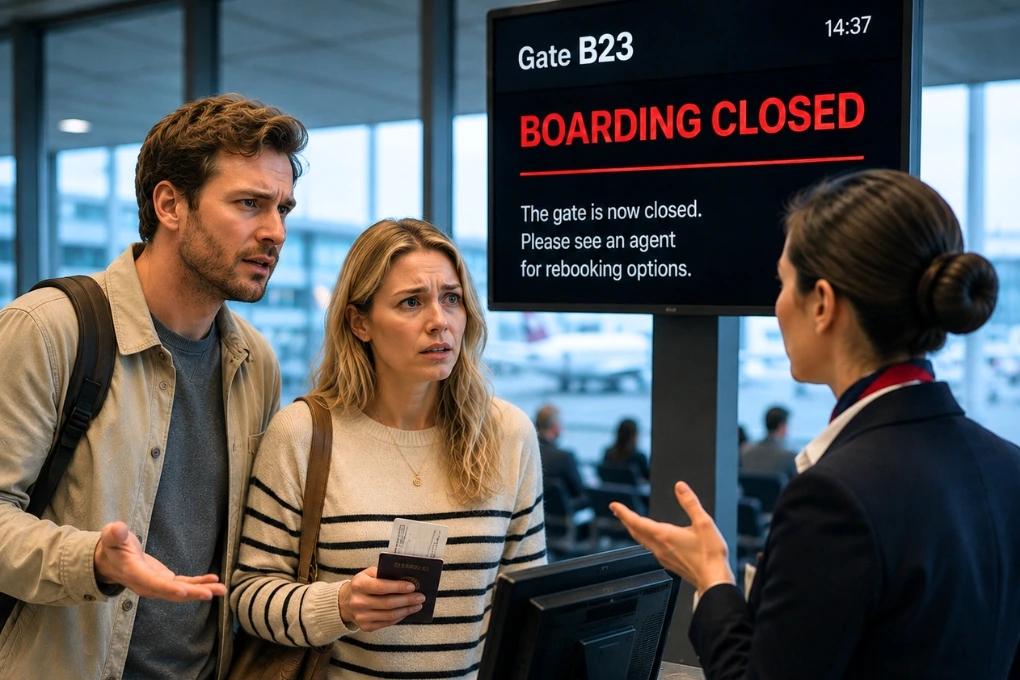
Refused boarding from an overbooked flight against your will? You could be entitled to up to £1,040 per couple in compensation under UK/EU 261, on top of a full refund or replacement flight. Air Delayed fights for what you are owed, on a no win, no fee basis.
If your flight was overbooked and you were turned away at the gate, you could be owed up to £520 per person, or £1,040 per couple in compensation. Under UK261 and EU261, passengers bumped from an overbooked flight against their will have the right to claim fixed compensation, no matter the price of their ticket or the airline they flew with.
You could be eligible if you had a valid ticket, checked in on time, and were still denied a seat because the airline sold more tickets than it had space for. Your flight must have departed from a UK or EU airport, or been arriving into one on a UK or EU registered carrier. The amount you receive depends on the distance of your route.
Find out where you stand in minutes, use our free overbooked flight compensation tool, enter your flight details, and we'll confirm your eligibility straight away.

Know your rights when your flight is overbooked
- If you were involuntarily refused boarding because your flight was overbooked, you are entitled to compensation of up to £520 per person or £1,040 per couple under UK/EU 261.
- Compensation is a fixed legal amount based on your flight distance, it is completely unrelated to the price you paid for your ticket.
- In addition to financial compensation, the airline must offer you either a full ticket refund or a replacement flight to your final destination at the earliest opportunity.
- You are also entitled to care and assistance at the airport, including meals, refreshments and hotel accommodation if an overnight stay is necessary, from the moment you are refused boarding.
- Airlines cannot use extraordinary circumstances to avoid paying overbooking compensation. Overbooking is a deliberate commercial decision made entirely by the airline.
- If you volunteered your seat in exchange for an incentive, your right to statutory compensation does not apply, but you still retain the right to a refund or replacement flight.
- UK passengers have up to six years (five years in Scotland) to claim overbooking compensation.
What is flight overbooking?
Flight overbooking, also known as overselling, is the practice of selling more tickets for a flight than there are seats available on the aircraft. It is entirely legal, and it happens on flights operated by virtually every major airline, every single day.
Airlines overbook deliberately. Using historical data and predictive modelling, they calculate the probability that a certain percentage of booked passengers will not show up, because of missed connections, last-minute changes or simply no-shows. By selling additional seats on top of the physical capacity of the aircraft, airlines aim to ensure every flight departs as close to full as possible, maximising revenue and keeping ticket prices competitive.
The system works most of the time. But when more passengers check in than the airline anticipated, which happens regularly, the airline faces a capacity problem of its own making. When that happens, someone gets turned away at the gate. That someone may be you.
Being turned away from a flight you have a confirmed booking for, checked in on time for, and arrived at the gate for, is one of the most frustrating experiences in air travel. Under UK/EU 261, it is also one of the strongest situations for claiming passenger compensation.
Voluntary vs involuntary refusal of boarding: the distinction that determines your rights
When a flight is overbooked, the airline is legally required to first ask passengers whether anyone is willing to voluntarily give up their seat in exchange for an incentive. This typically takes the form of travel vouchers, flight credits, an upgrade on a later service or a combination of these.
Voluntary refused boarding
If you agree to give up your seat in exchange for an incentive offered by the airline, this is voluntary refused boarding. By accepting, you waive your statutory right to the fixed financial compensation under UK/EU 261. You do, however, retain the right to:
- A full refund of your ticket, or
- A replacement flight to your destination
Think carefully before volunteering
The incentives airlines offer at the gate are often worth considerably less than the statutory compensation you would be entitled to if you held your ground and were involuntarily refused boarding. A £50 voucher is not the same as £350 in cash compensation.
Involuntary refused boarding
If the airline cannot find enough volunteers and selects passengers to remove from the flight without their agreement, this is involuntary refusal of boarding, and your full legal rights under UK/EU 261 apply immediately. You are entitled to financial compensation, a refund or replacement flight, and care and assistance at the airport.
Everything on this page that follows relates to involuntary refusal of boarding.
When are you entitled to overbooking compensation?
To qualify for overbooking compensation under UK/EU 261, the following conditions must all be met:
- You held a confirmed, valid booking for the flight
- You checked in on time — either online in advance or at the airport check-in desk within the required window
- You arrived at the departure gate by the stated deadline
- You held all required travel documents — a valid passport, any necessary visa, and your booking confirmation
- You were refused boarding against your will — you did not volunteer your seat
- Your behaviour was appropriate — you posed no safety, health or security risk to other passengers or crew
- Your flight either departed from a UK or EU airport, or was operated by a UK or EU airline arriving into the UK or EU
Which flights are covered?
| Journey Type | Airline | Covered? |
|---|---|---|
| Flight departing from a UK airport | Any airline | ✅ Yes |
| Flight departing from an EU airport | Any airline | ✅ Yes |
| Flight arriving at a UK airport | UK or EU airline | ✅ Yes |
| Flight arriving at a UK airport | Non-UK/EU airline | ❌ No |
| Flight arriving at an EU airport | UK or EU airline | ✅ Yes |
| Flight arriving at an EU airport | Non-UK/EU airline | ❌ No |
You could be owed up to £1,040 per couple
- No win, no fee
- 60 seconds Free compensation check
- 98% Success rate
How much overbooking compensation can you claim?
Overbooking compensation under UK/EU 261 is set at fixed amounts based on the distance of your flight. The amount is entirely independent of the price you paid for your ticket, whether you paid £29 or £2,900, the compensation figure is exactly the same.
| Flight Distance | Compensation Per Person |
|---|---|
| Up to 1,500 km | £220 |
| Between 1,500 km and 3,500 km | £350 |
| Over 3,500 km | £520 |
Important
These amounts may be reduced by 50% if the airline offers you a replacement flight that arrives at your final destination within a specific window of your original scheduled arrival time, two hours for short-haul flights, three hours for medium-haul and four hours for long-haul.
Real-world examples
- Cardiff to Amsterdam (~900 km): £220 per person
- London Stansted to Krakow (~1,550 km): £350 per person
- Edinburgh to Faro (~1,990 km): £350 per person
- Birmingham to Cancún (~8,700 km): £520 per person
- Glasgow to New York JFK (~5,370 km): £520 per person
Compensation is per passenger
A couple on a long-haul route could receive up to £1,040. A family of four travelling together could be entitled to up to £2,080 in total.
Your right to a replacement flight or full refund
Financial compensation is only one part of what you are owed. Immediately upon being refused boarding, the airline must offer you a clear choice between:
Option 1 — Replacement flight (re-routing)
The airline must rebook you onto the next available flight to your final destination at no extra charge. The replacement service does not have to be operated by the same airline, if the original carrier has no suitable availability, it must source an alternative with a different carrier.
You may also request re-routing on a later date that is more convenient for you, provided the airline can accommodate this.
Class changes
If your replacement flight is in a higher class of service than your original booking, the airline may not charge you any supplement. You travel at the originally purchased fare. If the replacement is in a lower class, the airline must reimburse you the difference in fare.
Option 2 — Full ticket refund
If you choose not to travel following the overbooking, you are entitled to a full reimbursement of your ticket price for all unused portions of your booking, paid within seven days.
If you have already used part of your journey, for example, an outbound flight, and are refused boarding on your return, you are entitled to a refund for the unused return leg. You may also request a return flight to your original departure point if you no longer wish to travel.
Key takeaway
You are entitled to both your refund or replacement flight and your financial compensation. These are two separate legal entitlements, one does not reduce or cancel out the other.
Your right to care and assistance at the airport
Unlike delayed flights, where your right to care typically begins after a two-hour wait, in an overbooking situation, the airline's duty of care begins immediately from the moment you are refused boarding.
The airline must provide:
- Meals and refreshments in reasonable proportion to any waiting time (usually issued as vouchers)
- Access to two complimentary phone calls, emails or fax messages
- Hotel accommodation and transfers to and from the airport if you are required to stay overnight
- A return flight to your original departure point if you decide not to travel at all
If the airline fails to provide these, do not leave without buying what you need. Keep every receipt, reasonable out-of-pocket costs for meals, accommodation and transport are reclaimable as part of your overall claim.
The airline owes you, it's time to collect
- No win, no fee
- Trusted by thousands of passengers worldwide
- Fast, simple and completely free to start
Why does overbooking happen, and why can airlines never use it as an excuse?
Overbooking is a business strategy, not an accident. Airlines invest significantly in the modelling and data systems used to calculate how many seats to oversell on any given route and departure. The decision to sell more tickets than the aircraft can carry is made deliberately, at a senior operational level, in the full knowledge that some passengers will occasionally be turned away.
This is precisely why overbooking cannot be used as an extraordinary circumstance to avoid paying compensation. Under UK/EU 261, extraordinary circumstances are events that are genuinely beyond the airline's control, severe weather, air traffic control strikes, security incidents. Overbooking is entirely within the airline's control. The airline chose to oversell the flight. The consequences of that decision fall on the airline, not the passenger.
Courts across the UK and EU have consistently upheld this position. No matter how an airline frames its communication with you at the gate, "the aircraft has been changed," "we have an operational issue," "we need to accommodate crew", if the underlying cause is that too many passengers have been sold a seat on a flight that cannot accommodate them all, your right to compensation stands.
How airlines select which passengers to refuse boarding
When a flight is overbooked and insufficient volunteers come forward, airlines must decide which passengers to deny boarding involuntarily. The criteria used vary between carriers, but common factors include:
- Check-in time — passengers who checked in last are often the first to be selected
- Fare class — passengers on lower fares may be prioritised for removal
- Frequent flyer status — elite members are typically protected from being refused boarding
- Travelling alone — solo travellers are more likely to be selected than families or groups
- No checked baggage — passengers travelling with hold luggage only are sometimes spared because their bags are already in the hold
Tip
The single most effective way to protect yourself from being refused boarding is to check in as early as possible, ideally online as soon as check-in opens, typically 24 hours before departure. Arrive at the gate well before the closing time. Passengers who are at the gate before the deadline are in the strongest possible legal position.
All the overbooking scenarios that affect your entitlement to compensation
| Scenario | Compensation Due? | Notes |
|---|---|---|
| Involuntarily refused boarding due to overbooking; checked in on time | ✅ Yes | Core qualifying scenario |
| Refused boarding; replacement flight arrives within the reduced compensation window | ⚠️ Reduced | Compensation may be cut by 50% depending on replacement arrival time |
| Voluntarily gave up seat in exchange for a voucher | ❌ No | Statutory compensation waived; refund/replacement still applies |
| Refused boarding because of late check-in | ❌ No | Passenger did not fulfil their obligation |
| Refused boarding because of missing or invalid travel documents | ❌ No | Passenger's own responsibility |
| Refused boarding due to disruptive behaviour | ❌ No | Safety grounds; airline's right to refuse |
| Refused boarding on a connecting flight; arrived 3+ hours late at final destination (single booking) | ✅ Yes | Rights assessed on total delay to final destination |
| Refused boarding on a connecting flight; separate tickets | ❌ No | Each ticket is an independent contract |
| Flight downgraded to a smaller aircraft; insufficient seats | ✅ Yes | Capacity change is the airline's responsibility |
| Crew displacement causes passenger to be removed | ✅ Yes | Crew logistics are within the airline's control |
How to claim overbooking compensation: your step-by-step guide
Being refused boarding is stressful, and the pressure at the gate can make it difficult to think clearly. Here is exactly what to do to protect your rights and maximise your claim.
Step 1: Do not volunteer your seat without considering the value
When the gate agent asks for volunteers, you are under no obligation to agree. Once you voluntarily give up your seat in exchange for an incentive, you waive your statutory right to fixed financial compensation. If no volunteers come forward and you are involuntarily refused boarding, your compensation entitlement is immediate and legally guaranteed.
Step 2: Get written confirmation from the airline
Ask the airline to provide written confirmation that you have been refused boarding and the stated reason. This document is crucial evidence if the airline later attempts to dispute your claim, attribute the denial to your own conduct, or misrepresent the cause as something other than overbooking.
Step 3: Keep all your travel documents
Hold onto your boarding pass, booking confirmation and e-ticket. Take photographs of departure boards and any notices displayed at the gate. If you do not have paper documents, request duplicates from the airline or access them via your booking account online.
Step 4: Claim care and assistance immediately
Do not wait to be offered meals or accommodation. Ask proactively for food and drink vouchers, access to communications and hotel accommodation if you will be stranded overnight. If the airline refuses, buy what you need and keep every receipt.
Step 5: Assert your right to choose your remedy
You have the right to choose between a replacement flight and a full ticket refund. Take your time to decide. Do not feel pressured into accepting the first alternative the airline offers, if the proposed replacement flight does not suit your needs, you may decline it and explore other options.
Step 6: Do not accept a voucher in place of cash compensation
Airlines regularly offer travel vouchers at the gate as a fast resolution. You are not obliged to accept a voucher in place of your statutory right to cash compensation. A voucher ties you to that airline, may come with restrictive terms, and could become worthless if the carrier enters administration.
Step 7: Note your actual arrival time at your final destination
If you accept a replacement flight, record the time you actually arrived at your final destination, specifically, when the aircraft doors opened. This determines whether the full or reduced compensation amount applies.
Step 8: Submit your claim through Air Delayed
Use our free compensation checker to confirm your eligibility in minutes. Air Delayed manages the full process, from the initial contact with the airline through to court proceedings if necessary, on a no win, no fee basis.
Ready to claim? Don't let your airline off the hook, you deserve compensation.
What if the airline offers you a seat in a different class?
If the only replacement flight available places you in a higher class of service than your original booking, the airline may not charge you any additional fare. You travel at your originally purchased price.
If, however, the replacement flight places you in a lower class of service, the airline must refund you the difference in price between your original class and the class you actually travelled in. The refund percentages are set by UK/EU 261:
| Downgrade Scenario | Refund of Original Ticket Price |
|---|---|
| Short-haul flight (up to 1,500 km) downgraded | 30% refund |
| Medium-haul flight (1,500–3,500 km) downgraded | 50% refund |
| Long-haul flight (over 3,500 km) downgraded | 75% refund |
This downgrade refund is in addition to any compensation you are entitled to, the two are separate entitlements.
Overbooking and business travel
If you are refused boarding whilst travelling for work, you receive the compensation, not your employer, even if the ticket was purchased by your company. UK/EU 261 recognises that it is the individual passenger who suffers the disruption, and the compensation belongs to them. This applies to civil servants, business delegates and employees whose travel costs are reimbursed by their organisation.
How long do you have to claim?
In England, Wales and Northern Ireland, you have up to six years from the date you were refused boarding to submit a compensation claim. In Scotland, the time limit is five years.
The period begins at the end of the calendar year in which the overbooking occurred. So if you were refused boarding on 3 September 2023, you have until 31 December 2029 to submit your claim, over six years in total.
Do not assume it is too late. Many passengers successfully claim overbooking compensation for incidents that took place several years ago.
Your Air Delayed checklist for overbooking compensation claims
- Do not volunteer unless you have considered your options — statutory compensation is worth more than most airline incentives offered at the gate.
- Get written confirmation of the refused boarding — including the stated reason.
- Keep every document — boarding pass, booking confirmation, e-ticket and all airline correspondence.
- Claim care and assistance immediately — meals, refreshments and accommodation are owed from the moment of denial; do not wait.
- Choose your remedy carefully — you can opt for a replacement flight or a full refund; take your time and do not be pressured.
- Decline vouchers unless genuinely satisfied — you are entitled to cash, not airline credit.
- Note your actual arrival time at your final destination if you took a replacement flight.
- Keep all receipts — out-of-pocket costs are reclaimable.
- Submit your claim through Air Delayed — we handle the full process on a no win, no fee basis.
Other airlines we can help you claim compensation from:
Other airports we can help you claim compensation from:

Your questions, answered
An overbooked flight is one where the airline has sold more tickets than there are seats on the aircraft. It is a deliberate commercial practice used by airlines to maximise the occupancy of each flight, based on predictions that a proportion of booked passengers will not show up. When more passengers arrive than anticipated, the airline has to remove some of them, and those removed involuntarily have strong legal rights under UK/EU 261.
Only if you were refused boarding involuntarily, that is, without your agreement. If you voluntarily gave up your seat in exchange for an incentive, your right to statutory financial compensation does not apply, though you retain the right to a refund or replacement flight. If you were turned away against your will, and you met all your obligations as a passenger, your entitlement to compensation is immediate and legally guaranteed.
The fixed amounts under UK/EU 261 are:
- Up to 1,500 km: £220 per person
- 1,500 km to 3,500 km: £350 per person
- Over 3,500 km: £520 per person
These amounts may be reduced by 50% if the airline provides a replacement flight that arrives within the specified time window of your original scheduled arrival. Every passenger holds an individual entitlement, couples and families each claim separately.
Yes. A ticket refund and financial compensation are two entirely separate legal entitlements. Choosing a replacement flight also does not cancel your right to financial compensation. You can receive both.
You are entitled to a partial refund of your ticket price, 30% for short-haul, 50% for medium-haul and 75% for long-haul flights, in addition to your compensation entitlement.
You travel at your original fare. The airline cannot charge you a supplement for the upgrade.
No. You always have the right to choose between a replacement flight and a full refund. If the alternative flight proposed does not suit your needs — for example, because it departs the following day, you may decline it and request your money back instead.
No. Once you voluntarily agree to give up your seat in exchange for an incentive, you waive your right to statutory compensation under UK/EU 261. Always consider the true value of what is being offered before agreeing to volunteer.
From the moment you are involuntarily refused boarding, the airline must provide meals and refreshments in proportion to any waiting time, access to two complimentary phone calls or emails, and hotel accommodation with transfers if an overnight stay becomes necessary. These rights are immediate, you do not need to wait two hours as you would with a delayed flight.
No. Overbooking is a deliberate commercial decision made by the airline. It is entirely within the airline's control and cannot be classified as an extraordinary circumstance under UK/EU 261. Courts across the UK and EU have consistently upheld this.
Ask for written confirmation from the airline of why you were refused boarding. If the underlying cause was that too many passengers had been sold seats on the flight, overbooking is the legal basis for your claim regardless of how the airline describes the situation operationally. Air Delayed can help you challenge any misleading characterisation.
Yes. Passengers on flights booked as part of a package holiday have the same rights under UK/EU 261 as those who booked independently. The standard eligibility criteria apply.
Yes. Every passenger, including children and infants with a confirmed ticket, holds their own individual right to compensation, provided the standard eligibility criteria are met.
Airlines frequently attempt to reject valid overbooking claims. Air Delayed will challenge the rejection on your behalf and, if necessary, pursue the matter through the courts, entirely on a no win, no fee basis.
Up to six years in England, Wales and Northern Ireland, and five years in Scotland. The clock starts at the end of the calendar year in which the overbooking occurred.