
AIR PASSENGER RIGHTS
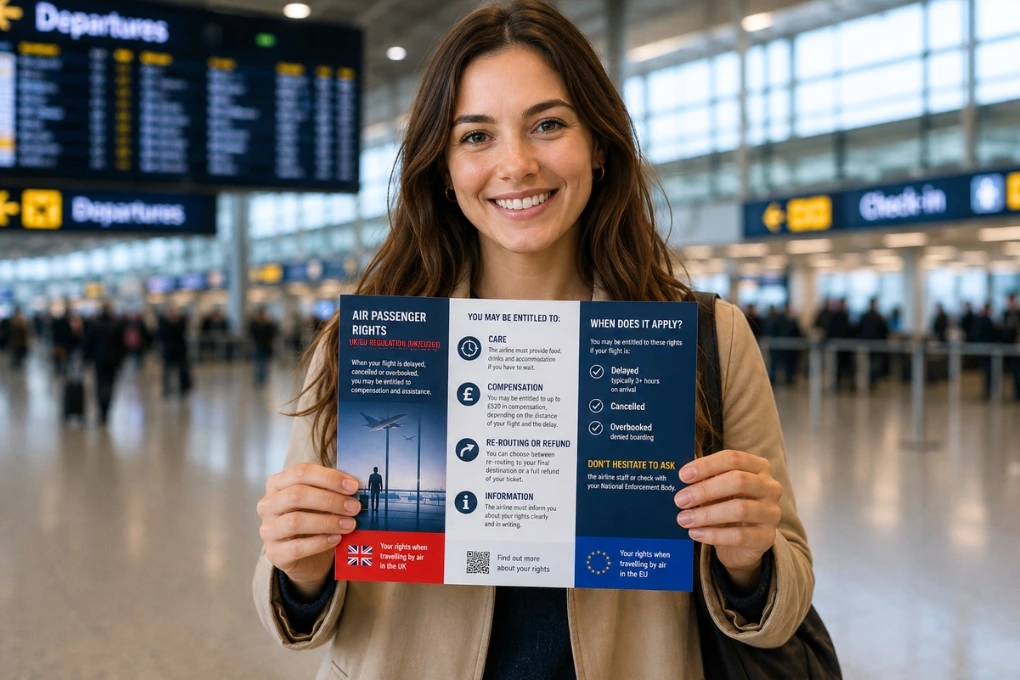
AIR PASSENGER RIGHTS
Every passenger has rights whether you are flying from the UK, Europe, or anywhere else in the world. Under UK/EU 261, airlines are legally required to compensate you when things go wrong. Air Delayed makes it simple for you.
Whether your flight was delayed, cancelled, overbooked, or you missed a connection, UK261 and EU261 give you legal rights that don't depend on your ticket price or airline, including compensation up to £520 per person, £1,040 per couple, plus refunds, re-routing, and care while you wait. Passengers with disabilities or reduced mobility have separate, additional rights to free assistance under a different regulation.
Not sure which situation applies to you? Use our free flight rights checker, enter your flight details, and we'll point you to the right claim.

Know your air passenger rights under UK/EU 261
Under UK/EU Law, passengers are entitled to compensation of up to £520 per person or £1,040 per couple when their flight is significantly delayed, cancelled at short notice, or they are denied boarding against their will.
Your rights apply regardless of your nationality, what matters is where your flight departs from, or which airline operates it.
In addition to financial compensation, airlines are legally required to provide you with a replacement flight or full ticket refund, plus care and assistance at the airport.
These rights cover flight delays of 3 or more hours, cancellations with fewer than 14 days' notice, denied boarding, and missed connections caused by the airline.
Airlines cannot avoid paying by claiming technical faults or internal strikes, these are within the airline's own control.
Depending on where you flew from, you may have up to six years to submit a claim.
What is UK/EU 261?
UK/EU 261 is the collective term for two parallel air passenger rights regulations that together protect the vast majority of passengers flying to, from and within the UK and Europe.
The original regulation, formally known as Regulation (EC) No. 261/2004, was adopted by the European Parliament on 11 February 2004 and entered into force across all EU member states on 17 February 2005. It was introduced because the number of passengers being denied boarding, experiencing short-notice cancellations and enduring long delays without any recourse had grown unacceptably high. The regulation set out clear, enforceable rights and fixed compensation amounts that airlines cannot reduce or negotiate away.
Following the United Kingdom's departure from the European Union, the UK Government incorporated the regulation into domestic law under the European Union (Withdrawal) Act 2018. This domestic version known as UK 261, came into force on 1 January 2021 and provides passengers with the same level of protection, with compensation expressed in pounds sterling rather than euros. The EU version continues to apply to qualifying EU flights as before.
The rights provided by UK/EU 261 are, for most purposes, identical in scope and value, and some flights are covered by both versions simultaneously, giving passengers the strongest possible legal footing.
Good to know
A flight operated by a UK airline departing from a Paris airport, for example, is covered by both the UK and EU versions of the regulation. Air Delayed will always identify which version gives you the best basis for your claim.
Who is protected under UK/EU 261?
You do not need to be a European or British citizen to be protected. UK/EU 261 applies based on where your flight departs from and which airline operates it, not the nationality of the passenger.
Coverage under the UK 261
| Flight Type | Airline | Covered? |
|---|---|---|
| Flight departing from a UK airport | Any airline | Yes |
| Flight arriving at a UK airport | UK or EU airline | Yes |
| Flight arriving at a UK airport | Non-UK/EU airline | No |
| Flight arriving at an EU airport | UK airline | Yes |
Coverage under EU 261
| Flight Type | Airline | Covered? |
|---|---|---|
| Flight departing from an EU airport | Any airline | Yes |
| Flight arriving at an EU airport | EU-registered airline | Yes |
| Flight arriving at an EU airport | Non-EU airline | No |
Travelling from outside the UK or EU?
If your journey begins in a country outside the UK or EU, for example, flying from the USA or Australia, you are only covered if your airline is UK or EU registered. If you are flying with a non-UK, non-EU carrier from a non-UK/EU departure point, UK/EU 261 does not apply. However, other international protections such as the Montreal Convention may still apply to your journey.
What rights does UK/EU 261 give you?
UK/EU 261 establishes three interconnected categories of rights for passengers affected by flight disruptions:
1. The right to financial compensation
When a disruption is within the airline's control, passengers are entitled to a fixed cash payment based on the distance of their flight. This is paid in addition to, not instead of any ticket refund or rebooking.
2. The right to a refund or replacement flight
Regardless of whether compensation is payable, the airline must always offer you either a full ticket refund or re-routing to your final destination at no additional cost.
3. The right to care and assistance
From the moment a qualifying disruption occurs, the airline is obligated to provide meals, refreshments, communications access and, where necessary, accommodation, regardless of whether the disruption was caused by extraordinary circumstances.
These three rights are independent of one another. You may be entitled to all three simultaneously, depending on your circumstances.
When does UK/EU 261 apply?
UK/EU 261 covers four types of disruption:
Flight delays
If your flight arrives at its final destination 3 or more hours later than the scheduled arrival time, you may be entitled to financial compensation, provided the delay was within the airline's control and not caused by extraordinary circumstances.
The key measurement is your actual arrival time at the destination, not when the flight departed, and not when it landed. Arrival time is legally defined as the moment the aircraft doors open.
Flight cancellations
If your flight is cancelled and you were informed fewer than 14 days before the scheduled departure date, you may be entitled to compensation. The exact amount depends on how much notice was given and how closely any offered replacement flight matched your original schedule.
You are always entitled to either a full ticket refund or re-routing, regardless of how much notice was provided.
Denied boarding
If the airline refuses to let you travel despite you holding a valid ticket, having checked in on time and being present at the gate, most commonly as a result of overbooking, you are entitled to compensation immediately, before you even board a replacement flight.
Missed connections
If a delay or cancellation on one leg of a connecting journey, booked under a single reservation, causes you to miss your onward flight and arrive at your final destination 3 or more hours late, your compensation entitlement is assessed based on the total distance from your origin to your final destination.
How much compensation can you claim?
Compensation under UK/EU 261 is set at fixed amounts determined by the distance of your flight. These figures cannot be reduced by the airline, and they are not affected by the price you paid for your ticket.
| Flight Distance | UK/EU 261 Compensation |
|---|---|
| Up to 1,500 km | £220 |
| Between 1,500 km and 3,500 km | £350 |
| Over 3,500 km | £520 |
For flights over 3,500 km where the airline offers a re-routed alternative flight that arrives within 4 hours of your original scheduled arrival time, the compensation may be reduced by 50%.
Compensation is per passenger.
A couple on a long-haul route could claim up to £1,040 combined. A family of four could be entitled to up to £2,080 in total.
Real-world examples
- Dublin to London (~450 km): £220 per person
- Amsterdam to Lisbon (~1,860 km): £350 per person
- Frankfurt to New York (~6,200 km): £520 per person
- London to Cape Town (~9,600 km): £520 per person
You could be owed up to £1,040 per couple
- No win, no fee
- 60 seconds Free compensation check
- 98% Success rate
Your right to care and assistance
Whether or not financial compensation is payable, including in cases involving extraordinary circumstances, the airline has a duty of care towards stranded passengers. From a wait of two or more hours, the airline must provide:
- Meals and refreshments in reasonable proportion to the waiting time (usually as vouchers)
- Access to two complimentary phone calls, emails or fax messages
- Hotel accommodation and transfers between the airport and hotel if an overnight stay becomes necessary
- A return flight to your original departure point if you choose not to travel at all
If the airline fails to provide these, retain all receipts. Reasonable out-of-pocket costs for meals, accommodation and transport are reclaimable as part of your claim.
If your delay exceeds 5 hours
and you decide not to travel, you are entitled to a full refund of your ticket and, if you have already begun your journey, a return flight home at no extra charge.
What are extraordinary circumstances?
Extraordinary circumstances are events that are genuinely beyond the airline's control, situations that could not have been avoided even if all reasonable precautions had been taken. When a disruption is caused by a genuine extraordinary circumstance, the airline is not required to pay financial compensation, although it must still provide care and assistance.
What qualifies as an extraordinary circumstance?
- Severe weather conditions — storms, heavy snow, dense fog, lightning strikes
- Air traffic control restrictions, including those related to military activity or political unrest
- Security threats — acts of sabotage, terrorist incidents, or bomb scares
- Natural disasters — volcanic eruptions, earthquakes or extreme flooding
- Third-party strikes — for example, by air traffic controllers or airport security staff
- Bird strikes or drone-related disruptions at the airport
What does NOT qualify as an extraordinary circumstance?
Airlines sometimes attempt to use extraordinary circumstances as a blanket excuse, but courts have consistently narrowed its scope. The following are not considered extraordinary circumstances:
| Situation | Extraordinary Circumstance? | Compensation Due? |
|---|---|---|
| Technical fault due to poor aircraft maintenance | No | Yes |
| Internal airline staff strike | No | Yes |
| Crew scheduling failure or staff shortage | No | Yes |
| Overbooking | No | Yes |
| Severe weather or natural disaster | Yes | No |
| Air traffic control strike | Yes | No |
| Security incidents or political unrest | Yes | No |
| Manufacturing defect notified by aircraft maker | Yes (possibly) | No |
Important
Even where extraordinary circumstances apply, the airline must still prove that it took all reasonable steps to minimise the disruption. If it did not, for example, by failing to explore rebooking options on other carriers, its exemption from paying compensation may not hold.
The airline owes you, it's time to collect
- No win, no fee
- Trusted by thousands of passengers worldwide
- Fast, simple and completely free to start
A brief history of UK/EU 261 and how passenger rights have grown
Understanding how this regulation developed helps explain why your rights today are as strong as they are.
- February 2004: The European Parliament and Council adopt Regulation (EC) No. 261/2004, replacing the weaker 1991 regulation on denied boarding.
- February 2005: UK/EU 261 enters into force across all EU member states, covering delays, cancellations and denied boarding for the first time under a single framework.
- November 2009, The Sturgeon Ruling: The Court of Justice of the European Union rules in Sturgeon v Condor Flugdienst GmbH that passengers on significantly delayed flights (arriving 3 or more hours late) are entitled to the same compensation as those on cancelled flights. This landmark decision dramatically expanded the scope of passenger rights.
- 2012, The Nelson Ruling: The CJEU confirms the Sturgeon decision in Nelson v Lufthansa, settling a period of legal uncertainty and firmly establishing the 3-hour delay rule in European law.
- 2018, Internal strikes confirmed as the airline's responsibility: The CJEU rules that wildcat strikes by airline staff do not constitute extraordinary circumstances, meaning airlines must pay compensation when disruptions are caused by their own employees' industrial action.
- December 2020, The UK version of UK/EU 261 comes into force: As part of the Brexit transition, the UK Government retains the regulation in domestic law under the European Union (Withdrawal) Act 2018. UK passengers retain the same rights as before, with compensation now expressed in pounds sterling.
- June 2025, The EU proposes a revised regulation: The European Commission formally adopts a proposed revision to UK/EU 261, aiming to modernise passenger rights in light of post-pandemic travel disruption and increased airline complexity. The revised regulation was presented to the European Parliament in June 2025, with further debate and voting expected through late 2025 and into 2026.
UK/EU 261 and the Montreal Convention: understanding the difference
UK/EU 261 is often the most powerful tool available to passengers, but it is not the only one. The Montreal Convention 1999 is a separate international treaty, signed by over 130 countries, that provides an additional layer of protection specifically for baggage issues and financial losses arising from flight disruptions on international routes.
| UK/EU 261 | Montreal Convention | |
|---|---|---|
| Covers | Delays, cancellations, denied boarding, missed connections | Baggage loss/damage/delay, financial losses on international flights |
| Compensation | Fixed amounts (£220–£520) | Variable, based on actual loss (up to approx. £1,500) |
| Applies to | Flights departing from UK/EU, or UK/EU airlines arriving in UK/EU | Most international flights between signatory countries |
| Extraordinary circumstances exemption | Yes | No — but claims must prove actual loss |
In some situations, for example, a long-haul flight disruption involving both a significant delay and lost luggage, you may be able to pursue claims under both frameworks simultaneously.
How to claim: your step-by-step guide
Whatever disruption you have experienced, the process for claiming your rights follows the same fundamental steps.
Collect as much evidence as possible before you leave. Take photographs of the departure board showing the delay or cancellation. Note the time and ask airline staff for written confirmation of the disruption and the stated reason. Keep every document, boarding pass, booking confirmation and any airline correspondence.
Do not wait for the airline to offer assistance. Ask proactively for meal vouchers, access to communications and hotel accommodation if you will be waiting overnight. If the airline refuses, purchase what you need and retain every receipt.
For delay and missed connection claims, your compensation entitlement hinges on your actual arrival time at your final destination, specifically, when the aircraft doors opened. Record this carefully, or check it afterwards via your boarding pass or the airline's flight tracking records.
Airlines often offer travel vouchers, meal credits or small goodwill gestures. These do not satisfy your statutory entitlement to cash compensation. You are under no obligation to accept a voucher, and doing so may make it harder to pursue your full legal rights later.
Use our free compensation checker to establish your eligibility in minutes. If your claim is valid, Air Delayed handles everything — from the initial contact with the airline through to court proceedings if necessary. You pay nothing unless we win.
Ready to claim? Don't let your airline off the hook, you deserve compensation.
Flights not covered by UK/EU 261
It is important to understand where UK/EU 261 does not apply, so you know what alternatives may be available to you.
UK/EU 261 does not cover:
- Flights departing from a non-EU, non-UK airport operated by a non-EU, non-UK airline
- Flights where the disruption was entirely caused by extraordinary circumstances beyond the airline's control
- Passengers who did not check in on time or failed to arrive at the gate by the stated deadline
- Passengers who caused the disruption through their own conduct (e.g. disruptive behaviour, invalid travel documents)
- Flights operated by very small aircraft, specifically, those with fewer than 20 seats used for commercial air transport
If your flight is not covered by UK/EU 261, the Montreal Convention, your airline's own conditions of carriage, or national consumer protection law may still offer a route to compensation or reimbursement. Air Delayed can advise you on which framework applies to your specific situation.
How long do you have to claim?
The time limit for submitting a claim varies depending on where your flight operated from:
| Jurisdiction | Time Limit |
|---|---|
| England, Wales and Northern Ireland | 6 years from the date of the disruption |
| Scotland | 5 years from the date of the disruption |
| Most EU member states | 2–3 years (varies by country) |
| France | 5 years |
| Sweden | 10 years |
The UK's six-year limitation period is one of the most generous in Europe, and many passengers successfully claim for disruptions that took place several years ago. Do not assume it is too late to claim.
Your Air Delayed checklist: what to do when a disruption occurs
- Stay calm and go to the airline desk — ask for written confirmation of the disruption, its cause, and your options.
- Keep every document — boarding pass, e-ticket, booking confirmation and any written communication from the airline.
- Photograph the departure board — timestamped photos showing your flight status are valuable evidence.
- Claim care and assistance immediately — you are entitled to meals, refreshments and communications from two hours of delay; do not wait.
- Record your actual arrival time — note when the aircraft doors open at your final destination.
- Do not sign any waivers — do not accept vouchers or sign documents that waive your statutory rights.
- Keep all receipts — meals, accommodation and transport costs incurred as a result of the disruption are reclaimable.
- Submit your claim through Air Delayed — we handle the full process on a no win, no fee basis, including court action if required.
Other airlines we can help you claim compensation from:
Other airports we can help you claim compensation from:
Your questions, answered
UK/EU 261 is the collective term for the air passenger rights regulations protecting travellers on flights to, from and within the UK and Europe. The EU version, formally Regulation (EC) No. 261/2004, has applied across EU member states since 17 February 2005. Following Brexit, the UK adopted its own equivalent, known as UK 261, which came into force on 1 January 2021 and provides identical rights for passengers flying to and from UK airports.
They are, for practical purposes, the same regulation. The EU version applies to flights departing from EU airports and flights arriving in the EU on EU-registered airlines. The UK version applies to flights departing from UK airports and flights arriving in the UK on UK or EU airlines. The compensation amounts are expressed in different currencies (euros under the EU version, pounds sterling under the UK version) but are broadly equivalent in value. Some flights are covered by both simultaneously.
Yes. UK/EU 261 applies to all passengers on qualifying flights, regardless of nationality or country of residence. What matters is the departure airport and the airline, not where you are from.
The fixed amounts under UK/EU 261 are:
- Up to 1,500 km: £220 per person
- 1,500 km to 3,500 km: £350 per person
- Over 3,500 km: £520 per person
These are paid per passenger and are unaffected by the price of your ticket.
You may be entitled to compensation for: a flight delay of 3 or more hours at your final destination; a flight cancelled with fewer than 14 days' notice; being denied boarding against your will; or missing a connecting flight (on a single booking) that causes you to arrive at your final destination 3 or more hours late — provided the disruption was within the airline's control.
Extraordinary circumstances are events genuinely beyond the airline's control, such as severe weather, air traffic control strikes, security incidents or natural disasters. When a disruption is caused by a genuine extraordinary circumstance, no financial compensation is payable, although the airline must still provide care and assistance. Technical faults due to poor maintenance and internal airline strikes are not extraordinary circumstances.
It depends on your situation. If you accepted re-routing to your destination, you are entitled to financial compensation but not a ticket refund. If you chose not to travel at all, you are entitled to both a full refund and financial compensation. The two rights are independent, but your choice of remedy affects which combination you can pursue.
From two hours of waiting, the airline must provide: meals and refreshments in proportion to the delay; access to two complimentary phone calls or emails; and hotel accommodation with transfers if an overnight stay is required. These obligations apply regardless of whether extraordinary circumstances are involved.
If your flight falls outside the scope of UK/EU 261, for example, because it departed from a non-EU, non-UK airport on a non-EU, non-UK airline, you may still have rights under the Montreal Convention, your airline's own conditions of carriage, or national consumer law. Air Delayed can help you identify which framework best applies to your journey.
The Montreal Convention 1999 is an international treaty covering passengers on international flights between the 130+ signatory countries. It applies specifically to claims for lost, delayed or damaged baggage, and to financial losses arising from flight disruptions on qualifying international routes. It works alongside, not instead of UK/EU 261, and in some cases you may be able to claim under both simultaneously.
Yes. Passengers travelling on flights that form part of a package holiday have the same rights under UK/EU 261 as those who booked independently. The standard eligibility criteria apply.
Yes. Each passenger on a disrupted flight holds their own individual right to compensation. You can submit a claim on behalf of other passengers in your group, including children and infants who held a confirmed ticket.
Airlines frequently reject valid claims at the first attempt, often citing extraordinary circumstances or disputing the delay duration. Air Delayed's legal team will challenge the rejection on your behalf and, if necessary, take the matter to court — entirely on a no win, no fee basis.
In England, Wales and Northern Ireland you have 6 years. In Scotland, 5 years. In most EU member states, the period ranges from 2 to 3 years, though France allows 5 years and Sweden 10 years. The UK's limitation period is one of the longest in Europe.
Use Air Delayed's free compensation checker to confirm your eligibility in under two minutes. If your claim is valid, we handle every step of the process, including any necessary legal action, at no upfront cost to you.