
DENIED BOARDING COMPENSATION
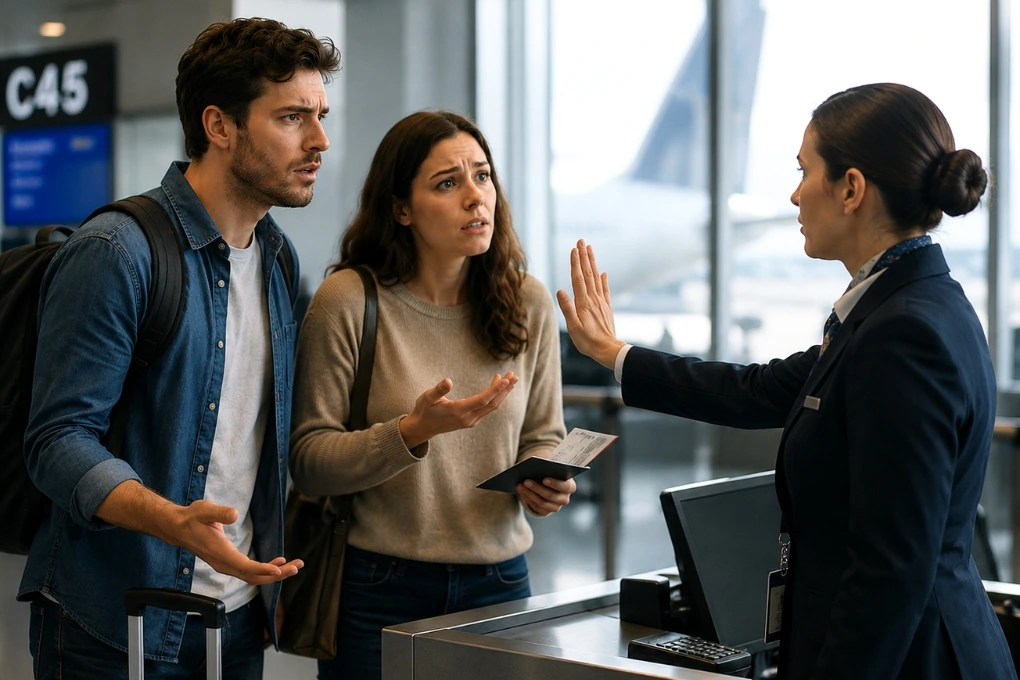
DENIED BOARDING COMPENSATION
Have you been denied boarding? You could be entitled to up to £1,040 per couple in compensation under UK/EU law. Air Delayed makes it simple, no win, no fee. Check your claim free in minutes.
Being denied boarding is frustrating, but did you know your airline could owe you up to £520 per person, or £1,040 per couple in compensation? Under UK261 and EU261, passengers who were denied boarding against their will have the right to claim fixed compensation, no matter the price of their ticket or the airline they flew with.
You could be eligible if you had a valid ticket, checked in on time, and were still turned away at the gate because the flight was overbooked. Your flight must have departed from a UK or EU airport, or been arriving into one on a UK or EU registered carrier. The amount you receive depends on the distance of your route.
Find out where you stand in minutes, use our free denied boarding compensation tool, enter your flight details, and we'll confirm your eligibility straight away.

Know denied boarding compensation rights
If you were refused boarding against your will despite checking in on time with valid documents, you are entitled to financial compensation of up to £520 per person or £1,040 per couple.
Compensation amounts are fixed by law and are based on your flight distance, not the price of your ticket.
In addition to compensation, the airline must provide you with a full ticket refund or a replacement flight to your destination.
You are also entitled to care and assistance at the airport, including meals, refreshments, and hotel accommodation if needed.
Airlines cannot refuse to pay simply because you were on a budget fare or travelling as part of a group booking.
UK passengers have up to six years (five years in Scotland) to make a claim for denied boarding.
What does "denied boarding" actually mean?
Denied boarding is when an airline refuses to let you travel on a flight you legitimately booked, even though:
- You have a confirmed reservation
- You checked in on time
- You hold all the required travel documents
- You were present at the gate before the deadline
The most common cause is overbooking, a widespread (and entirely legal) practice where airlines sell more seats than they have available, gambling on the assumption that some passengers will not show up. When everyone does turn up, someone gets left behind. That someone may have legal grounds to claim substantial compensation.
Being denied boarding is also sometimes called being "bumped off a flight." Whatever you call it, if it happened to you through no fault of your own, your rights are clear.
Voluntary vs involuntary denied boarding: understanding the difference
Not all cases of denied boarding are the same, and the difference matters enormously when it comes to your entitlement to compensation.
Voluntary denied boarding
When a flight is overbooked, airlines are required by law to first ask for volunteers who are willing to give up their seats in exchange for benefits — typically travel vouchers, flight credits, or upgrades. If you agree to step aside voluntarily, you forfeit your statutory right to financial compensation.
However, even if you volunteer, you still retain the right to:
- A full refund of your ticket price, or
- A replacement flight to your destination
Think carefully before volunteering
The incentives offered by airlines are often worth less than the statutory compensation you'd be entitled to if you waited to see whether you were involuntarily bumped.
Involuntary denied boarding
If the airline cannot find enough volunteers and selects passengers to remove from the flight without their agreement, this is involuntary denied boarding. This is where your full legal rights kick in, including the right to financial compensation on top of a refund or replacement flight.
The rest of this page focuses on involuntary denied boarding and the rights that come with it.
When are you entitled to denied boarding compensation?
To qualify for denied boarding compensation under UK/EU Regulation (EC) No. 261/2004 (retained into UK domestic law following Brexit), the following conditions must all be met:
- You checked in on time, either online or at the airport check-in desk
- You held all required travel documents, including a valid passport, any necessary visa, and your booking confirmation
- You arrived at the departure gate with sufficient time before the closing deadline
- Your behaviour was appropriate, you were not disruptive, aggressive, or intoxicated
- You posed no safety or health risk to yourself or other passengers
- You held a confirmed, valid ticket
If all of the above apply and the airline still refused to let you board, you very likely have a valid claim.
Which flights are covered?
UK and EU air passenger rights law applies to:
| Journey Type | Airline | Covered? |
|---|---|---|
| Flight departing from a UK airport | Any airline | Yes |
| Flight departing from an EU airport | Any airline | Yes |
| Flight arriving at a UK airport | UK or EU airline | Yes |
| Flight arriving at a UK airport | Non-UK/EU airline | No |
| Flight arriving at an EU airport | UK or EU airline | Yes |
| Flight arriving at an EU airport | Non-UK/EU airline | No |
You could be owed up to £1,040 per couple
- No win, no fee
- 60 seconds Free compensation check
- 98% Success rate
How much compensation can you claim?
Denied boarding compensation is set at fixed amounts under UK law. Crucially, the figure does not depend on how much you paid for your ticket, it depends solely on the distance of your flight.
| Flight Distance | Compensation Per Person |
|---|---|
| Up to 1,500 km | £220 |
| Between 1,500 km and 3,500 km | £350 |
| Over 3,500 km | £520 |
Real-world examples
To help put these figures in context:
- Birmingham to Amsterdam (~900 km): £220 per person
- Edinburgh to Lisbon (~1,450 km): £220 per person
- Bristol to Krakow (~1,580 km): £350 per person
- Manchester to Cairo (~3,600 km): £350 per person
- London Stansted to Bangkok (~9,500 km): £520 per person
- Glasgow to Toronto (~5,600 km): £520 per person
Good to know
Compensation is paid per passenger, not per booking. If four members of your family were all denied boarding, each person is individually entitled to the full amount.
Your right to a refund or replacement flight
Financial compensation is only one part of what you're owed. The airline must also give you a choice between:
Option 1 — Full ticket refund
A complete reimbursement of your ticket price — including any unused portions of your journey, paid within seven days.
Option 2 — Replacement flight
Re-routing to your final destination at the earliest possible opportunity, or on an alternative date of your choosing. The replacement flight does not have to be operated by the same airline, if the original carrier has no suitable availability, they must source an alternative.
These two rights work alongside each other
Choosing a replacement flight does not cancel your right to financial compensation, and claiming a refund does not either. You are entitled to both.
Your right to care and assistance at the airport
Regardless of which option you choose, and regardless of whether extraordinary circumstances are involved, the airline must provide you with care and assistance while you wait. This includes:
- Meals and refreshments in reasonable proportion to the length of your wait (typically provided as vouchers)
- Access to two complimentary phone calls, emails or fax messages
- Hotel accommodation and transport between the airport and the hotel if an overnight stay becomes necessary
- Return transport to your original point of departure, if you have decided not to travel
These are not optional, they are legal requirements. If the airline fails to provide them, keep all your receipts. You can seek reimbursement of any reasonable out-of-pocket expenses incurred as a result.
One important difference from flight delays and cancellations
In a denied boarding situation, you do not need to wait two hours before the airline's duty of care obligations begin. They apply from the moment you are refused boarding.
Why do airlines overbook? Understanding the root cause
Overbooking is a deliberate commercial strategy. Airlines use historical data and predictive models to calculate how many passengers on any given flight are likely not to show up, those who miss connections, book multiple options, or simply fail to travel. They then sell a corresponding number of additional tickets on top of the actual seat count, aiming to ensure every flight departs full.
The system works most of the time. But when more passengers arrive than expected, the result is involuntary denied boarding, and the consequences fall on passengers who did nothing wrong.
Because overbooking is a deliberate decision made by the airline, it is squarely within their control. This is why involuntary denied boarding due to overbooking almost always qualifies for full statutory compensation.
The airline owes you, it's time to collect
- No win, no fee
- Trusted by thousands of passengers worldwide
- Fast, simple and completely free to start
All the reasons you might be denied boarding and whether each one entitles you to compensation
Not every reason for denied boarding gives rise to a compensation claim. Here is a full breakdown:
| Reason for denied boarding | Entitles you to compensation? | Notes |
|---|---|---|
| Overbooking (airline sold too many seats) | Yes | Most common cause; fully within the airline's control |
| Operational aircraft downgrade (smaller plane used) | Yes | Airline's responsibility to manage capacity |
| Crew shortage or rostering failure | Yes | Internal staffing is the airline's responsibility |
| Invalid, expired or missing passport | No | Passenger's responsibility to hold valid documents |
| Missing or incorrect visa | No | Passenger's responsibility to meet entry requirements |
| Late check-in at airport | No | Passenger did not fulfil their obligation |
| Failure to arrive at the gate on time | No | Passenger missed the gate deadline |
| Disruptive, threatening or aggressive behaviour | No | Airline entitled to refuse boarding on safety grounds |
| Visible signs of intoxication | No | Safety concern within the passenger's own control |
| Health risk to other passengers (e.g. highly contagious illness) | No | Extraordinary circumstance; airline may be exempt |
| Weight and balance issues on smaller aircraft | Possibly | Depends on whether the airline could have anticipated it |
| Security watchlist or travel ban | No | Outside the airline's control |
How to claim: Your step-by-step guide
Being denied boarding is stressful, and it is easy to feel overwhelmed in the moment. Here is exactly what to do to protect your position and maximise your chances of a successful claim.
When the gate agent asks for volunteers, you are under no obligation to agree. Once you voluntarily give up your seat in exchange for an incentive, you waive your right to statutory compensation. If you choose to hold your ground, the airline must honour your booking or compensate you properly.
Request written confirmation from airline staff at the gate, clearly stating that you have been denied boarding and the reason for it (e.g. overbooking). This document is often crucial evidence if the airline later disputes your claim or attempts to attribute the denial to your own conduct.
Hold onto your boarding pass, booking confirmation, e-ticket and any correspondence from the airline. If you do not have physical copies, take photographs or request duplicates. These establish that you held a valid booking and checked in on time.
Do not wait to be offered care. Proactively ask the airline for meal vouchers, access to communications, and hotel accommodation if you are stranded overnight. If they refuse or fail to provide them, buy what you need and keep every receipt.
Assert your right to choose between a full ticket refund or re-routing to your destination. You are not obligated to accept whatever the airline initially offers, if their proposed alternative flight does not suit your needs, you may arrange your own and charge the cost to the airline.
Airlines often offer travel vouchers as a quick resolution. You are not obliged to accept them in place of a cash refund or statutory compensation. Vouchers are tied to that airline, may come with restrictions, and could become worthless if the airline faces financial difficulties. A cash payment is always more valuable.
Use our free compensation checker to confirm your eligibility. If you have a valid claim, Air Delayed will handle the entire process, contacting the airline, managing all correspondence and escalating to court proceedings if necessary. You pay nothing unless we win.
Ready to claim? Don't let your airline off the hook, you deserve compensation.
What about denied boarding on a connecting flight?
If you are denied boarding on one leg of a connecting journey, for example, at a hub airport whilst transiting to your final destination, your rights apply to the overall disruption to your journey, not just the cancelled or denied segment.
Provided all flights were booked under a single reservation, you are entitled to compensation based on the distance from your original departure airport to your final destination. The airline is also obligated to arrange onward travel or a full refund, depending on your preference.
If your connecting flights were booked on separate tickets, each leg is treated as a standalone contract, meaning you would need to pursue any claims independently for each flight.
Denied boarding and business travel
If you are denied boarding whilst travelling for work, you receive the compensation, not your employer, even if they paid for the ticket. UK law recognises that it is the individual passenger who suffers the inconvenience, and the compensation belongs to them accordingly.
This applies equally to civil servants, official delegates and those travelling on government business.
How long do you have to claim?
In England, Wales and Northern Ireland, you have up to six years from the date of the flight to make a denied boarding compensation claim. In Scotland, the time limit is five years.
The period begins at the end of the calendar year in which the denial took place. For example, if you were denied boarding on 15 March 2023, you have until 31 December 2029 to submit your claim.
Don't assume it is too late, many passengers successfully claim for incidents that happened years ago.
Your Air Delayed checklist for denied boarding claims
Use this as your go-to reference whenever you face a denied boarding situation:
- Don't volunteer — hold your ground until you know whether you will be bumped involuntarily, as this preserves your full compensation rights.
- Get written confirmation — ask gate staff to confirm in writing that boarding was refused and the stated reason.
- Keep every document — boarding pass, booking confirmation, any airline correspondence, and gate notices.
- Claim airport assistance immediately — meals, refreshments and communications are owed to you from the moment of denial; don't wait to be offered them.
- Choose your remedy — you can opt for a full refund or an alternative flight. Take your time to decide and do not feel pressured.
- Decline vouchers unless they are genuinely worthwhile — you are entitled to cash, not airline currency.
- Save all receipts — accommodation, meals, transport and any other expenses caused by the delay may be reclaimable.
- Submit your claim through Air Delayed — we handle the legal process from start to finish, on a no win, no fee basis.
Other airlines we can help you claim compensation from:
Other airports we can help you claim compensation from:

Your questions, answered
It is a legally fixed payment that an airline must make if it refuses to let you board a flight against your will — for example, because the flight was overbooked. In the UK, this is governed by UK Regulation (EC) No. 261/2004, which sets out standardised compensation amounts based on your flight distance.
Only if you were denied boarding involuntarily — i.e. without your consent — and you met all your obligations as a passenger (checked in on time, held valid documents, arrived at the gate on time, behaved appropriately). If you volunteered your seat, statutory compensation does not apply.
The amounts are set by law at:
- Up to 1,500 km: £220 per person
- 1,500 km to 3,500 km: £350 per person
- Over 3,500 km: £520 per person
These figures are fixed regardless of your ticket price.
Yes. A ticket refund and financial compensation are two separate entitlements. Choosing to take a replacement flight also does not cancel your right to compensation.
You are under no legal obligation to accept a voucher. You are entitled to a cash refund of your ticket price and separate cash compensation. Accept vouchers only if you are genuinely happy with the terms — once accepted, it may be harder to pursue the full statutory amount later.
No. You have the right to either accept the rerouting the airline proposes or request a full refund. If the alternative flight offered is unsuitable, you may make your own arrangements and seek reimbursement from the airline.
The airline carries the burden of proof. If you were at the gate on time, gather any evidence you have — timestamped photos, gate announcements, written confirmation from staff. Air Delayed's legal team can help you challenge this if the airline disputes your version of events.
Yes. Denied boarding compensation under UK Regulation 261/2004 applies regardless of whether your flight was booked independently or as part of a package. The key eligibility criteria remain the same.
Your claim is made against the operating airline — the one that actually flew (or refused to fly) you. Even if you booked through a third-party carrier or travel agent, the operating airline is responsible for meeting your passenger rights.
No. If you were denied boarding because your travel documents were invalid or insufficient, this falls outside the scope of airline compensation law. Always check that your passport, visa and any entry requirements are in order well before travel.
In most cases, denial of boarding on health grounds is treated as an extraordinary circumstance, meaning compensation may not be payable. However, if you can demonstrate that the airline's health policy was not clearly communicated in advance, or that the decision was disproportionate, it is worth checking your eligibility.
Up to six years in England, Wales and Northern Ireland, and five years in Scotland. The clock starts at the end of the calendar year in which the flight was denied.
Airlines frequently reject valid claims at the first attempt. Air Delayed will escalate the matter on your behalf — including taking legal action where needed — without any upfront cost to you.
Yes. Each passenger — regardless of age — who was involuntarily denied boarding holds their own individual right to compensation, provided they held a confirmed ticket and the usual eligibility criteria are met.
Yes. Compensation belongs to the individual passenger who was denied boarding, not the person or company who paid for the ticket. You receive the money, not your employer.